
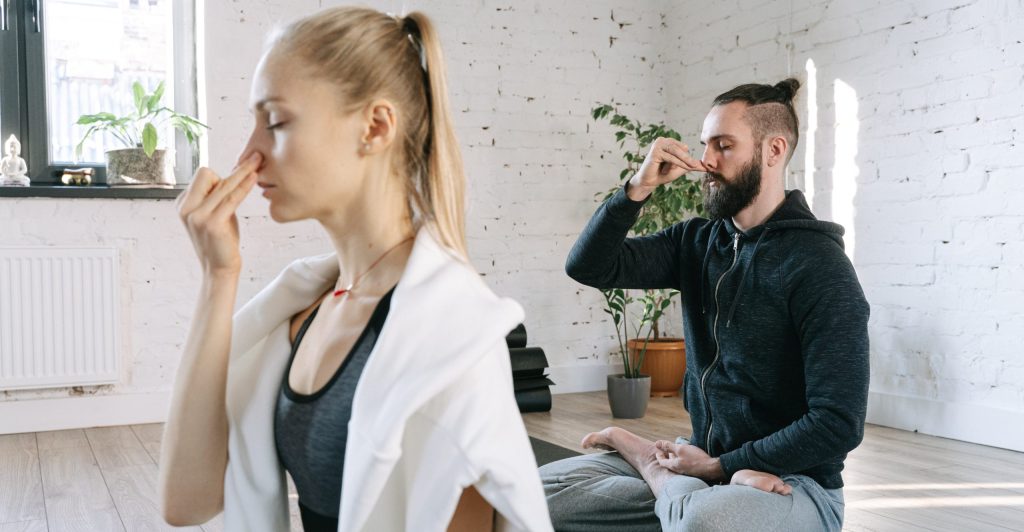
“Take a deep breath” sounds simple but is very sound advice, particularly because breathing is fundamental to life. Centuries of Ayurvedic wisdom advises us to pay close attention to our breathing, to shake off negative energy and warm up your mind, body and spirit.
Pranayama is another name for yogic breathwork that’s performed by regulating the breath in a specific sequence. Simply, it is the art and science of breath regulation for increased physical, mental and spiritual wellness.
BENEFITS OF PRANAYAMA
Pranayama is an excellent daily practice where breathwork can aid in balancing emotional states. Harvard researcher Herbert Benson coined the term The Relaxation Response in his book of the same name where he talks about controlled breathing as being key in counteracting the nervous system’s “fight or flight” response to stress. The breath-brain circuit acts as a pathway to calm that can be used in the morning, prior to an exam, before your next interview or during meditation, thus maximizing pranayama benefits. It can be tapped into for boosting your baroreflex sensitivity, the internal mechanism that keeps blood pressure from spiking by lowering heart rate. Less stress on blood vessels is also a huge plus for cardiovascular health.
An altered pranayama breathing rhythm can also aid in strengthening immunity. “What’s happening when you’re stressed is that your own body is giving itself multiple shots of that anti-inflammatory hormone, and so that tunes down your immune system’s ability to do its job to fight infection,” says Esther Sternberg, physician and author of several books on stress and healing.
BEST PRANAYAMA FOR EACH DOSHA
In Ayurveda, there are 3 doshas or constitution types called Vata, Pitta and Kapha. Adapt your breathing to your dominant dosha to get the maximum benefits. Take our quick dosha quiz if you would like to determine your dosha before you go ahead.
Vata dosha:
Vata is a combination of air and ether, which manifests as dryness, coldness, roughness and mobility. One of the best breathing techniques for your dosha is Alternate Nostril Breathing (Anulom Vilom). The rhythmic alternate inhalation and exhalation helps restore balance while grounding and soothing Vata.
How to practice pranayama for Vata dosha:
- Sit comfortably in a warm place with your back stretched. Close your eyes.
- Then, close the right nostril by applying gentle pressure with the right thumb.
- Gently and slowly inhale through the left nostril.
- Then, close the left nostril with the ring finger of the right hand.
- Lift the thumb from the right nostril and exhale through your right nostril.
- Inhale through the right nostril and exhale through the left nostril, continuing at a comfortable and controlled rhythm.
The breathing should be soft, smooth, relaxing and comforting to still Vata’s windy, wavering energies. Doing this pranayama practice daily for 5-10 minutes can expand Vata’s lung capacity, enhance feelings of tranquility and promote mental clarity. Alternate Nostril Breathing (Anulom Vilom) can be very balancing whenever you feel anxious or exhausted.
Pitta dosha:
Pitta dosha is made up of water and fire, which make its principal qualities manifest as warmth, sharpness, light and oily. Cooling Breath (Sheetali Pranayama) is the most favourable for cooling down Pitta’s fiery nature.
How to practice pranayama for Pitta dosha:
- Sit up with your back straight and your shoulders back.
- Place your hands on your laps with the palms facing up and close your eyes.
- Slowly sip air by rolling your tongue (or inhaling through the teeth with lips parted if you find you cannot roll your tongue comfortably).
- Then, close the lips and touch the tip of the tongue to the roof of the mouth.
- Slowly exhale through the nose.
- Repeat by inhaling deeply through the curled tongue and exhaling through your nose. Swallow every so often if the throat feels dry.
- Establish a calming and relaxing rhythm and continue for about 3 to 5 minutes until you feel refreshed.
This cooling breath pranayama comes in very handy for aggravated Pitta during the hot summer months when the heat causes body temperature, rashes and anxiety to rise. Discreet enough to practice on a crowded subway car or elevator, it can also help with excessive sweating and soothes digestive disturbances due to high levels of acidic secretions in the stomach.
Kapha dosha:
Earth and water come together in Kapha dosha to create the qualities of heaviness, stickiness, dampness and coolness. Bhastrika is one of the most beneficial Kapha balancing pranayamas as it stimulates warmth and opens up the energy channels of the body.
How to practice pranayama for Kapha dosha:
- Sit up with your back straight and your shoulders back.
- Place your hands on your laps and close your eyes.
- Relax or soften your facial muscles and jaw.
- Inhale deeply through the nose, while flaring open the ribs.
- Exhale fully, allowing the lungs to deflate as much as possible without causing discomfort.
- Continue for about 15-20 seconds. Keep your spine straight and stretched to help the excess Kapha or mucus flow out.
- Return to normal breathing slowly.
Contraindication: Always perform Bhastrika on an empty stomach.
Bhastrika benefits those suffering from respiratory disorders and congestion in the nose, sinuses and lungs. It is one of the best breathing exercises to perform during spring (considered Kapha season), when we tend to get a runny nose and feel sluggish overall.
WHEN TO PRACTICE PRANAYAMA
Traditionally, pranayama was practiced at dawn on an empty stomach when one started their day with yoga asanas. Asana (posture) shifts the body towards stillness that is needed for Pranayama (mind discipline). Pranayama eases the mind into a meditative state.
Excellent as a morning ritual, you can bring pranayama into your schedule whenever you find 15 minutes to yourself. The only rule is not to practice immediately after meals. Breathwork before meals will stoke the digestive fire and soothe the mind to promote optimal digestion and absorption.
Pranayama can be coupled with practices like Nasya and Neti as they help detox and open up the nasal passages. As ancient texts say, “When breath is still, mind is still”. The ebb and flow of your breath can deepen your yogic focus and is one of the best forms of self-care available right under your nose!