;
CELEBRATING INTERNATIONAL WOMEN’S DAY: INSPIRE INCLUSION, INVEST IN WOMEN

International Women’s Day (IWD), celebrated annually on March 8th, stands as a global tribute to women’s achievements and a rallying cry for gender equality. This day is marked by a myriad of activities that emphasize progress, recognize challenges, and inspire action for a more inclusive world. Let’s delve into the history of IWD, its celebration in India, the theme for 2024, and explore why this day is crucial in the ongoing fight for women’s rights. 

INTERNATIONAL WOMEN’S DAY HISTORY:

The roots of International Women’s Day trace back to the early 20th-century labor movements in North America and Europe. The first National Women’s Day in the United States in 1909 set the stage, and in 1910, German women’s rights activist Clara Zetkin proposed the idea of an International Women’s Day. The inaugural celebration took place on March 19, 1911, in several European countries. The United Nations officially joined the celebration in 1975, reinforcing the significance of the day globally. [1]

INTERNATIONAL WOMEN’S DAY CELEBRATION IN THE USA:

International Women’s Day made its debut in the United States in 1909, marking a pivotal moment in the global pursuit of women’s rights. Observances of this day encompass a spectrum of activities, ranging from fundraisers and conferences to demonstrations and festivals. One noteworthy recognition is the International Women of Courage Award, presented by the United States Department of State. This distinguished accolade acknowledges the remarkable contributions of women worldwide who have demonstrated exceptional courage, leadership, and resourcefulness in championing women’s rights within their respective countries. The award stands as a testament to their unwavering commitment to advancing the cause of gender equality. [2]

International Women of Courage Award

INTERNATIONAL WOMEN’S DAY CELEBRATION IN INDIA:

India has observed International Women’s Day since the early 20th century, gaining momentum during the independence movement when women actively participated in protests. In recent years, India’s celebrations have included seminars, workshops, and cultural performances, shedding light on both achievements and challenges faced by women. The day is marked with enthusiasm, honoring women from various fields for their contributions to society.

UN WOMEN

INTERNATIONAL WOMEN’S DAY THEME 2024:

The theme for International Women’s Day 2024, “Inspire Inclusion,” emphasizes the necessity of a world where everyone is included, respected, and valued, irrespective of gender. It calls for action to ensure women’s participation in leadership roles, decision-making processes, and economic opportunities, aiming to break down barriers and challenge stereotypes. [3]

WHY IS WOMEN’S DAY CELEBRATED? 

International Women’s Day is a celebration of women’s achievements and contributions to society, coupled with an awareness campaign for gender equality and women’s rights. It serves as an opportunity to recognize progress and acknowledge challenges, promoting continued action toward global gender parity.


IDEAS FORWOMEN’S DAY CELEBRATION:

  • Organize a Panel Discussion: Invite women leaders and experts to discuss gender equality, women’s empowerment, and related issues.
  • Host a Cultural Event: Showcase the talents and achievements of women in the arts through concerts, art exhibitions, or film screenings.
  • Community Service: Engage in volunteer activities such as supporting women’s shelters, organizing donation drives, or participating in community clean-up events.
  • Educational Workshops: Conduct workshops on financial literacy, self-defense, and mental health awareness to empower women and girls.
  • Social Media Campaign: Use social media platforms to raise awareness about gender equality and promote positive messages about women’s achievements.

ACCORDING TO UN WOMEN, ADDRESSING THESE FIVE CRITICAL AREAS REQUIRES COLLABORATIVE EFFORTS: [4]

1

Investing in Women as a Human Rights Issue: 

The urgency is palpable. Gender equality stands as the paramount human rights challenge, with benefits extending to everyone.

2

Ending Poverty:

The aftermath of the COVID-19 pandemic and ongoing conflicts have pushed an additional 75 million people into severe poverty since 2020. Immediate intervention is imperative to avert the risk of over 342 million women and girls enduring poverty by 2030.

3

Implementing Gender-Responsive Financing: 

With conflicts and escalating prices looming, a concerning projection indicates that 75% of countries may slash public spending by 2025. This potential reduction poses a grave threat to women and their indispensable services, underscoring the need for gender-responsive financing.

4

Shifting to a Green Economy and Care Society:

The existing economic structure disproportionately impacts women. Advocates recommend a transformative shift towards a green economy and care society, aiming to amplify women’s voices and rectify the existing imbalance.

5

Supporting Feminist Change-Makers: 

Despite spearheading transformative initiatives, feminist organizations receive a mere 0.13% of official development assistance. This underscores the imperative to bolster support for these change-makers who play a pivotal role in advancing gender equality globally.


International Women’s Day is an occasion to celebrate women’s achievements, recognize ongoing challenges, and advocate for gender equality. The theme “Inspire Inclusion” encourages collective action to create a more inclusive world. As we celebrate on March 8, 2024, under the theme ‘Invest in women: Accelerate progress,’ let’s stand together, break biases, and work towards a more inclusive and equal world for all. Join the movement using the hashtag #InvestInWomen.

INTERNATIONAL WOMEN’S DAY: STORIES WORTH KNOWING 

On March 8, 2024, the world will unite to celebrate International Women’s Day under the theme ‘Invest in women: Accelerate progress.’ Join the movement and take a stand by using the hashtag #InvestInWomen. This year’s campaign theme, “Inspire Inclusion,” invites us to reflect on what it truly means to foster diversity and empowerment.

INSPIRE INCLUSION: CELEBRATING DIVERSITY ON INTERNATIONAL WOMEN’S DAY 2024

International Women’s Day is an annual global celebration of women’s achievements and a reminder of the ongoing journey towards gender equality. In 2024, the campaign theme, “Inspire Inclusion,” takes center stage, emphasizing the significance of diversity and empowerment in all facets of society.

The theme underscores the pivotal role of inclusion in achieving gender equality. It calls for action to break down barriers, challenge stereotypes, and create environments where all women are valued and respected. “Inspire Inclusion” encourages everyone to recognize the unique perspectives and contributions of women from all walks of life, including those from marginalized communities.

STORIES WORTH KNOWING:

Deepali Jain

You are in control of your life!

Guided by her first manager, Geetha Rajagopal, Deepali learned the pivotal lesson of seizing opportunities to shape destiny. She emphasizes individual autonomy to define success, be it as a mother, wife, or CEO. Acknowledging mentor Nicky Wakefield, Deepali values aligning choices with life goals, and advocating for support over external perspectives. Her condensed narrative is a beacon of self-empowerment, urging others to embrace personal agency. Influenced by the 2 women: Geetha and Nicky, Deepali’s journey exemplifies transformative recognition of personal control and diverse paths to success, encouraging individuals to craft their narratives with confidence and resilience.

Head of Digital Transformation – APAC at The Adecco Group
Singapore

“Dare to be extraordinary. No matter how challenging the road ahead is, move forward with conviction and believe in yourself. Don’t underestimate your ability to achieve great things!” 

Runaway Juno

I’m a Solo Traveling Married Woman, Why Not?

In a unique and empowering story, a married woman reflects on her experiences as a solo traveler. Despite societal expectations, she challenges norms by traveling alone while her husband works abroad. The couple embraces freedom in their marriage, emphasizing trust, shared values, and commitment as the foundation of their strong relationship. This story challenges stereotypes and showcases the beauty of unconventional partnerships. 

Shrankhla Holecek

UMA: A Legacy of Integrity and Empowerment

Founder Shrankhla Holecek’s story adds a unique dimension to our celebration. Raised in India with a rich background in Ayurveda and holistic medicine, Shrankhla witnessed misappropriations of her cultural heritage in Beverly Hills. Frustrated, she founded UMA, a skincare line rooted in integrity and tradition.

With UMA, Shrankhla aimed to give women access to powerful, artisanal products that honor her family’s heritage. UMA, named after Shrankhla’s remarkable aunt, celebrates the spirit of every woman. The brand embodies simplicity, integrity, and equilibrium, reflecting true beauty. Shrankhla’s aunt, who never wore makeup, inspired UMA’s commitment to celebrating the inherent beauty within each of us.

JOIN THE MOVEMENT: #InvestInWomen

As we celebrate International Women’s Day 2024, let’s unite under the banner of “Inspire Inclusion.” Let’s break down barriers, challenge stereotypes, and create a world where every woman is valued. Join the movement by using the hashtag #InvestInWomen and share stories of empowerment, diversity, and inclusion. Together, we can accelerate progress and create a more inclusive future for all.

INTERNATIONAL DAY OF WOMEN & GIRLS IN SCIENCE: CELEBRATING THE POWER OF FEMALE SCIENTISTS & AYURVEDIC EXPERTS

As the sun rises, painting a golden hue across the lush landscape, Ayurveda awakens our senses to the rhythms of nature and the essence of life itself. With its roots deeply embedded in the serene expanse of the Indian subcontinent, Ayurveda has been nurtured and refined over centuries, earning its title as the “Science of Life.”

In this blog, we pay tribute to the profound contributions of female Ayurvedic practitioners and Scientists, whose impact is as powerful as the most exquisite blend of aroma-therapeutic oils. Their intuitive understanding of the delicate balance of elements and their skillful application of nature’s healing rhythm has played an instrumental role in Ayurveda’s evolution, just like the sacred herbs they expertly employ.

Furthermore, we delve into the significance of the International Day of Women and Girls in Science, established by the General Assembly in 2015. This day serves as a reminder of the crucial role that women play in the fields of science and technology. We explore the importance of promoting gender equality and creating opportunities for women to thrive in these realms.

The Symbolic Colors of International Women’s Day:

Purple, green, and white are the symbolic colors of International Women’s Day. Purple represents justice and loyalty, while green symbolizes hope. White, although controversial, represents purity. These colors originated from the Women’s Social and Political Union (WSPU) in the UK in 1908.

A Paradigm Shift in Ayurveda:

The entry of women into the traditionally male-dominated field of Ayurveda in India since the 1980s marks a significant social and historical event. Their increasing participation challenges the long-standing control of certain castes and medical lineages by men. However, women’s overall workforce participation in science remains low. This article explores the impact of women’s work in science and Ayurveda on regional identity and the global market, shedding light on the challenges they face and the resources they mobilize for success.

Promoting Women and Girls in Science:

Celebrated on February 11, the International Day of Women and Girls in Science aims to foster equal access and participation in scientific pursuits. UNESCO and UN-Women collaborate with institutions and civil society partners to achieve this goal. Gender equality is a global priority for UNESCO, and empowering young girls and supporting their education is crucial for development and peace.

The Need for Gender Equality in STEM:

Despite the critical importance of Science, Technology, Engineering, and Mathematics (STEM) fields to national economies, achieving gender equality in STEM remains a significant challenge. This blog underscores the necessity to address this disparity and emphasizes the benefits of diversity in research, which brings fresh perspectives, talent, and creativity.

2024 Campaign Theme: Inspire Inclusion:

The theme for the IWD 2024 campaign is “Inspire Inclusion.” By inspiring others to understand and value the inclusion of women, we can create a better world. When women themselves feel included, they experience a sense of belonging, relevance, and empowerment.

Key Facts:

  • Globally, only 33.3% of researchers are women, and women make up just 35% of students in STEM fields.
  • In 2016, only 30% of countries with available data achieved gender parity among researchers.
  • Female researchers receive smaller grants compared to their male counterparts. Moreover, although women represent 33.3% of all researchers, only 12% are members of national science academies.
  • In cutting-edge fields like artificial intelligence, women comprise just 22% of professionals.
  • Despite a shortage of skills in technology-related fields, only 28% of engineering graduates and 40% of computer science and informatics graduates are women.
  • Female researchers often face shorter, less lucrative careers. Their work is underrepresented in renowned journals, and they are frequently overlooked for promotions.

Gloria Steinem, a world-renowned feminist, journalist, and activist, once eloquently expressed, “The story of women’s struggle for equality belongs to no single feminist, nor any one organization, but to the collective efforts of all who care about human rights.” On International Women’s Day, let us embrace this sentiment and strive to make a positive difference for women everywhere.

Let’s also honor the remarkable achievements of some trailblazing women:

1

Dr. Varalakshmi Yanamandra:

An esteemed Ayurvedic health coach, who specializes in supporting women who experience digestive illnesses, gut issues, and food cravings through transformative health coaching. As our very own Ayurvedic expert, she believes that achieving balance in our Agni, or digestive system, is often the crucial first step towards overall well-being. With her extensive experience as a certified Ayurveda Practitioner, she has successfully helped countless individuals suffering from gut imbalances and chronic pain.

 KNOW MORE

2

Kadambini (Basu) Ganguly:

She was the first female graduate of the British Empire and became one of South Asia’s first female physicians trained in Western medicine. Overcoming barriers, Ganguly gained admission to Calcutta Medical College in 1884, received further training in Scotland, and established a successful medical practice in India. She also broke barriers by becoming the first woman speaker in the Indian National Congress.

KNOW MORE

3

Dr. Indira Hinduja: 

She holds the distinction of being the first Indian woman to deliver a test tube baby on August 6, 1986. Additionally, she pioneered the Gamete Intra Fallopian Transfer (GIFT) technique, which resulted in the birth of India’s first GIFT baby on January 4, 1988. As an esteemed gynecologist, obstetrician, and infertility specialist based in Mumbai, Hinduja developed an oocyte donation technique for menopausal and premature ovarian failure patients. She gained recognition for delivering the country’s first baby using this technique on January 24, 1991.

KNOW MORE

4

Kalpana Chawla:  

Born on March 17, 1962, Chawla made history as the first Indian-American astronaut and the first Indian woman in space. Serving as a mission specialist and primary robotic arm operator, she embarked on her first spaceflight on Space Shuttle Columbia in 1997. Chawla’s exceptional contributions earned her the accolade of being called a “terrific astronaut.” Tragically, on February 1, 2003, the space shuttle Columbia disintegrated over central Texas, claiming the lives of all seven crew members, including Chawla.

KNOW MORE

5

Vanitha Muthayya, Ritu Karidhal, and Swati Mohan:

For the first time in India’s history, two women scientists from the Indian Space Research Organisation (ISRO) led the country’s second lunar mission, Chandrayaan-2. Vanitha Muthayya served as the project director, while Ritu Karidhal assumed the role of the mission director. And Swati Mohan played a crucial role in ensuring the spacecraft’s precise orientation throughout its voyage to Mars and its successful landing on the planet’s surface. Their leadership and expertise propelled India’s space exploration endeavors to new heights.

KNOW MORE

The International Day of Women and Girls in Science reminds us of the critical role women play in science and technology communities. It emphasizes the need to strengthen their participation and promote gender equality in these fields. Let’s celebrate the achievements of women in science and inspire future generations to pursue their passions without limitations.

BEAUTY SECRETS UNVEILED: JEAN SEO OF EVOLUE BEAUTY

For over a decade, the founder of Evolue Beverly Hills, Jean Seo, has curated the best collection of products to suit the needs of her discerning celebrity clients. Using her actresses as test bunnies, she created Evolue Skincare for anti-aging, and LUÉ Skin for anti-acne. Her insights will reduce your time spent primping, and enhance your pampering experience.

Jean Seo’s 7 Simple Tips For Enhancing Natural Beauty

1. Always use a shower filter.

Hard water becomes carcinogenic when it evaporates due to chlorine and chloramine used to keep water disinfected. Secondarily, it dries out hair and skin.

2. Dry your face with paper towels.

Your towels are never 100% free of bacteria. To remove makeup, Jean created the first cold pressed jojoba oil based Gentle Cleanser which is a makeup remover that dissolves impurities without clogging pores, and leaves skin hydrated.

3. Blending repeatedly is the secret to applying foundation flawlessly. 

4. Every girl who knows makeup knows the importance of a good highlighter. 

Use them on your best features to accentuate them.

5. New skin is good skin. Make sure you exfoliate 1-3 times a week

 depending on your skin sensitivity and the harshness of your product. I suggest using something more frequently, that is more mild for consistent glow without redness or irritation. Evolue Resurfacing Grains and LUÉ Erase was created for this exact purpose. Use LUÉ Clear to get rid of cystic acne before it erupts (the type of acne that hurts and leaves scars).

6. Hands should always be well manicured.

 If you can’t maintain them, keep them clear or nude.

7. Lastly, sleep well.

 It is good for your skin. There is nothing more attractive than a person who looks well rested without a worry in the world. That is natural beauty.

MOM KNOWS BEST (ESPECIALLY WHEN IT COMES TO BEAUTY)

In honor of Mother’s Day, we sat down with our founder Shrankhla to talk about the wellness habits, skin care rituals, and Ayurvedic principles passed down to her as a child in India. Read on for some of the best tips she received from the special women in her life!

Mom

The first beauty “rule” I remember was to avoid traditional face washes — only gentle, good-enough-to-eat ingredients were allowed on our faces. Think gram flour, honey, and oats rather than anything that could strip the skin of its natural oils. For a deeper treatment, my mother would create a mask of sandalwood and almond paste, which helped inspire UMA’s collection of masks! I’m always grateful she taught me the importance of preserving the skin’s natural balance — it meant acne-free teenage years – and by and large problem-free skin now. I really have Mom (and her Ayurvedic roots!) to thank!

Grandma

Like many grandmothers, mine was all about food — specifically, beauty through food. A stickler for purity and freshness – she’d ensure we were always served nutritious meals, laden with “beauty boosting” ingredients – nuts to help our skin glow, ghee for vitality, and fresh home-made yogurt for better hair. My busy schedule today rarely allows me to go the extra mile like she did, but when I do – I know I glow for weeks. (Yes – I realize much of that is probably how I feel – but that’s over 50% of looking good, right?!) 

Aunt Uma (our namesake)

My aunt was very much like a mother to my sister and me, and taught me the value of rituals. Sunday mornings spent sitting around the TV also meant weekly body gommages and haircare (like overnight oil treatments, and clarifying lemon treatments for the scalp). It still warms my heart to think about how Aunt Uma instilled the value of self-care in us in her own special, dedicated way!

AYURVEDIC LIFE WISDOM FROM UMA’S FOUNDER, SHRANKHLA HOLECEK

Ayurveda reigns in India. More than 75 percent of the country’s population uses some form of the ancient science of medicine, which proves its deep roots continue to grow in the collective culture—even after its origins more than 5000 years ago. This loyalty extends to the Western world. In the United States, Ayurveda “is considered a complementary healthcare option, with many Americans employing Ayurvedic elements such as massage, meditation, or cleansing therapies,” according to the University of Minnesota.

For UMA’s founder, Shrankhla Holecek, Ayurveda has been a pillar in her life since she was born. As a child growing up in India she would watch her parents perform ayurvedic rituals and prepare healthy food with the utmost intention. Shrankhla learned from her parents to foster a deep connection to herself. In witnessing even the most simple, quotidian moments—as she describes below—she learned there are endless opportunities for reflection, care, and pleasure. This holistic approach helps to maintain mind-body balance by creating harmony between the body, mind, and spirit. It is the ethos of Ayurveda—and what makes it so beautifully compelling.

SHRANKHLA’S TRUTHS FROM HER FAMILY

Truth #1: Fresh Food Is Nourishing Food

“Fresh seasonal food has always been paramount for my family. My parents always prepare fresh meals for every breakfast, lunch, and dinner, Vegetables are bought daily. There was always fresh yogurt when I was growing up. There are never any leftovers or frozen meals served.”

Truth #2: Know Your Dairy

“Milk is always fresh—ideally straight from a cow (a free-roaming, hormone-free, beloved cow). It always arrived every morning at my home growing up. We then pasteurized it to use for yogurt and any leftover milk went to make ghee (clarified butter).” 

Truth #3: There’s Beauty In Herbs, Pastes, And Botanicals

“I never saw my mother use soap on her face or shampoo in her hair. She often used sandalwood masks and uptans (pastes of chickpea, oat, walnut powders) for facial cleansers. Twice a week she used a combination of reetha (Sapindus mukorossi), cypriol, and hibiscus to wash her hair, sometimes adding in fresh yogurt for additional conditioning. I’ve never seen my mom get a zit, and she didn’t have a single grey until her late forties.” 

Truth #4: Massage Is A Powerful Health Tool

“My parents both get a full Abhyanga massage with mustard oil every day (my mother has recently paused). It’s a self-care practice that they were both very committed to—ironically, not for relaxation or indulgence but because they strongly believe in its health benefits.”

Truth #5: Giving Is Receiving

“The Vedic texts suggest dedications in your life should be segmented in four parts: the first twenty-five years to academia and strengthening professional pursuits; the second twenty-five years to domestic pursuits like marriage, family and children; the third to giving back, transition away from wealth and tradition pursuits, and the fourth to renunciation of traditional material and emotional afflictions and a general reflection on life overall.

I have seen my parents become more and more philanthropic over the years. I love all that my parents do but by far my favorite is the sanctuary for abandoned cows where they rescue and rehabilitate abandoned cows from the streets of India.”

DESIGNER LAN JAENICKE ON CREATIVITY, BEAUTY AND FOCUS


Lan Jaenicke remembers when she accidentally burned her parents’ carpet. She was eleven, living in Beijing with her mother and father. A precocious and artistic child, Jaenicke was always drawing and making her own clothes. There was a pair of pants she needed to fix. “I was like, I want to iron this; I want to hem these pants,” she recalls. So she ironed them on her parents’ bedroom floor—of course, not understanding the concept of heat and carpet, she says, laughing.The small singe was a precursor to the artistic flame that steadily grew in Jaenicke. The daughter of two artists—her mother, a clothing designer, her father a writer—it was as if the creativity spectrum was waiting for Jaenicke to claim her spot. She did—and then created an entirely new spectrum with her fervor for authenticity. After growing up in Beijing and attending boarding school in England, Jaenicke pivoted, earning a Bachelor of Science degree in mathematics at University College London. She then went to work in Hong Kong and New York in advertising. Eventually, coming full circle, she came back to the arts, earning an MFA in fashion merchandizing and design.Today she is a lauded clothing designer known for her exquisite tailoring and loyalty to pure, raw materials. She founded her bespoke clothing line, Lan Jaenicke, in 2008, which she says was an organic evolution of her love of creating. Her pieces are ethereal. Dreamy. Rich cashmere jackets that seem to alchemize as they hug the body. Whispery silk dresses that kiss the skin.What’s so unique about Jaenicke is her capacity for seeing and celebrating individuality. As much as her designs are extensions of her artistic intelligence, they’re items that mold into her customers’ self-expression. “I always want to create a piece that’s not about the garment but about enhancing a woman for who she is and who she wants to be,” she says.Which circles back to the singed carpet. Jaenicke has always honored her determination and vision—which has helped her nourish a life and career that is unequivocally genuine. We were thrilled to catch up with her recently to ask for her insight on nourishing creativity, running a business, and, of course, how she perceives—and honors—beauty.

A MINUTE WITH LAN JAENICKE


Q

1. How has creativity played a role throughout your life?

A

Creativity was always part of my upbringing. My parents are both very creative. They sent me to all kinds of art classes starting around the age of seven. I was learning the skills of an artist or painter, which continued when I went to boarding school.

My mom was a designer, so I was always watching her play with fabrics. I would get a scrap of left over fabric and make something out of it. I’ve always altered things and made my own clothes, even when I was quite young. That has always been a playground for me.


Q

 2. What is your design process like today?

A

Every day is different. Everything starts very organically with an idea, thought, or curiosity to see how things would work together and then it evolves into a final product. Yesterday, for instance, I was working with this dress, playing with the texture, the smoothness of the cashmere, the structure of the silk, and then putting it all together.

So often, I may start with one idea and in the end it evolves into something completely different


Q

3. How do you want your customers to feel when they wear your designs?

A

 I want them to feel like themselves. It’s not about a label, it’s not about a look, or a trend, it’s about confidence and being comfortable. I feel that women are the most beautiful when they feel like themselves. That’s my intention.


Q

4. You’ve talked about how you keep your designs very clean so your customers can wear the pieces in their own way. How do you honor this?

A

Everything I create is very understated, with very clean lines and pure materials, like 100 percent cashmere and 100 percent silk. I emphasize the purity of the fabric. I believe the raw materials need to be clean and pure to create something beautiful out of it, very much like with skincare or food.

From there, I always consider that everyone is different, with their own lifestyle and ways of doing things. Therefore I want to create pieces that leave room for my customers to twist the pieces into their own versions.

I always talk with my customers: What do they already own in their wardrobe? What is their lifestyle? Do they travel often? All of these are part of the consideration of a design piece. Essentially, it’s not a garment, it’s an extension of you, a part of your life to serve you and to make you feel good.


Q

5. What have been some of the biggest rewards and challenges of starting and running your company?

A

Focus is very important. Throughout the years I have heard “you should do this” or “you should do that.” But I have always focused on what I do the best and what I love and am not distracted by other things. I’ve stayed true to pure materials and clean designs. I’ve worked on building the core of the brand to extend our signature pieces, so when people hear the name Lan Jaenicke they know it’s about coats and jackets, about pure cashmere and silk.

It’s important to know your vision and to be very confident in what you want to do so your brand grows organically from within you. It’s not about someone else’s curiosity or demand. Only you know your customers and yourself best. Trust that intuition and the integrity of your own intentions.


Q

6. How do you implement harmony in your life and in your career?

A

Harmony is actually a state of mind. You can feel out of balance but if you switch your mind to feel the right balance, you can find harmony again. It’s very much like focus or a form of meditation. You can sync yourself at any time. We all have that ability to do that. We’re in charge of our own peace and harmony.

It’s also about having an awareness: to know what works for you, what triggers you, and what you’re okay and not okay with. It’s important to surround yourself with an environment filled with beautiful and uplifting spirits. Then you will feel at harmony much more easily. As we grow, as we have more experiences in our lives. The noise we experience when we’re twenty is not as big of a deal when we’re forty because we have so much more wisdom. It’s so good to learn lessons and to challenge ourselves, but there are also times when we need to create a peacefulness around us so we can recharge.


Q

7. What is your approach to beauty? Are there products or rituals you love?

A

Beauty is embracing who you. Again, it’s self love and a state of mind. If you feel beautiful, you are beautiful. When you choose beauty products, choose the ones that make you feel good. For example, I love the UMA rose toner because it makes me and my skin feel nourished. It smells heavenly and there’s also an emotional connection because I got it from a beautiful friend.

In terms of what I think are the best things to do, I say do what makes you feel good. That may be spending a long time in front of the mirror, doing a facial massage or simply brushing your hair. Take your time, take a bath, or just do nothing. Just lying in a little chair and reading a book. Feeling relaxed and peaceful is so important. So there’s no stress and you are doing something completely that allows you to feel total bliss.

To learn more about Lan Jaenicke, visit: lanjaenicke.com


WHY NAVEL THERAPY IS A POWERFUL SELF-CARE PRACTICE: A Q&A WITH HEATHER BAINES


Navel therapy or navel oiling—filling the belly button with warm oil or ghee—is a centuries-old practice for detoxifying, nurturing, and treating ailments in the body.

In Ayurvedic tradition, the navel (nabhi) represents the origin of life. It links mother and child before birth and provides a hub for nutrients to flow between their bodies. “This is the place of our first nourishment as we developed in our mother’s womb,” says Heather Baines AD C-AP. The philosophy of navel therapy (also referred to as nabhi chikitsanabhi purana, or nabhi basti) informs us that the navel continues to serve as a center of balance in adulthood. It is where the nabhi marma—a central and very powerful energy center—resides says Baines, an Ayurvedic Doctor certified by the National Ayurvedic Medical Association, and founder and managing director of Roots of Wellness, a cooperative of Ayurvedic practitioners located in Boulder, Colorado. And because the belly button presents an abundance of blood vessels and pathways to the body’s extremities, the absorption of oils through the navel pathways is strong.

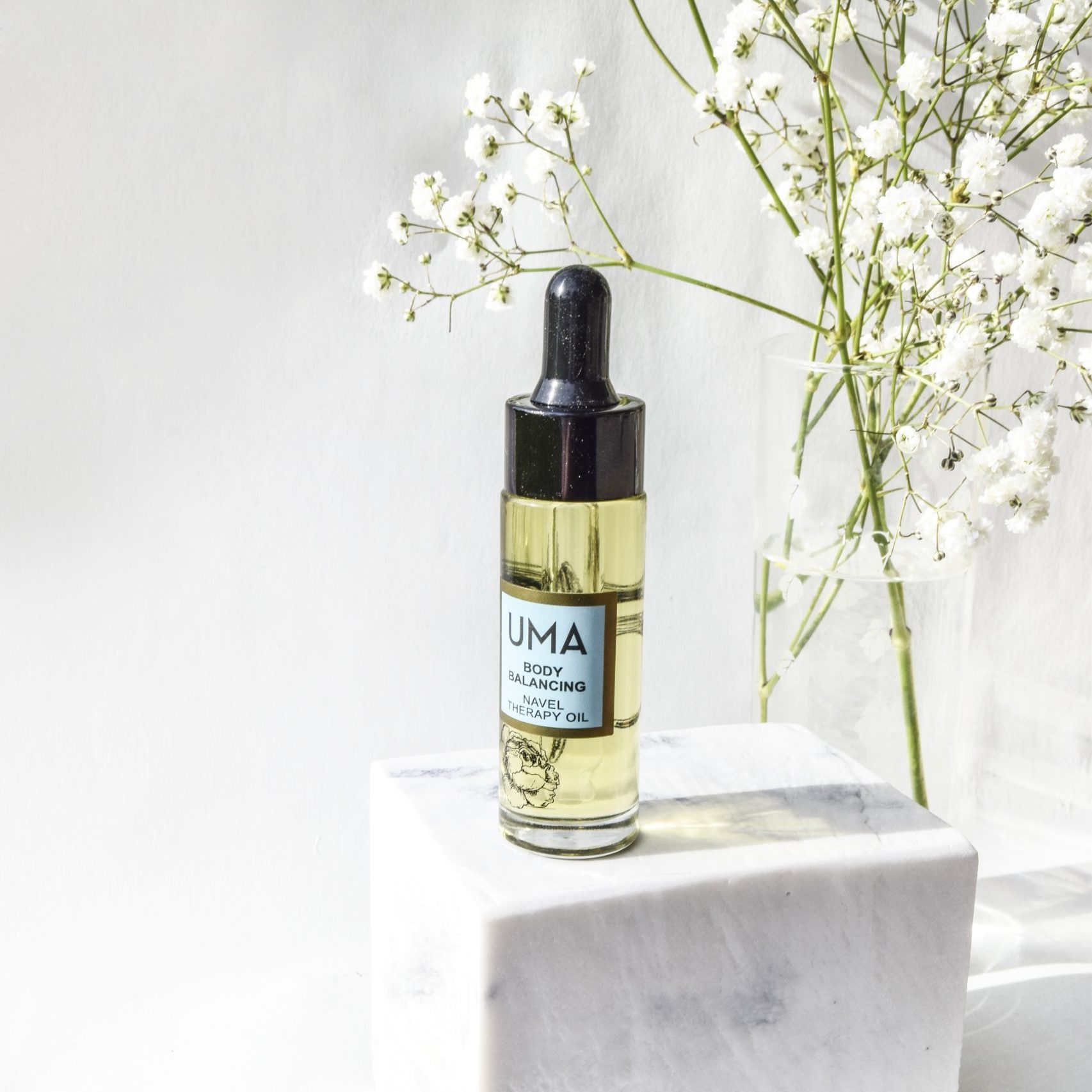
Having recently launched our new Navel Therapy Oils (one for reinvigorating skin, one for balancing the digestive system and renewing energy reserves) we asked Baines for her insight on navel therapy, why it’s beneficial for our health, and how the practice is a simple, renewing, blissful act of self-care. “Give yourself the time and space to luxuriate in warm oils applied to the navel,” says Baines. “Your mind, your body, and your health will benefit and your skin will glow with daily practice.”

TALKING NAVEL THERAPY WITH HEATHER BAINES, AD C-AP

Q

How does navel therapy work?

A

The daily practice of applying warm oil to the navel gently stabilizes Vayu, the air element seated in Manipura, the third chakra and energy center located within the navel and abdomen. 

Warm oil is recommended for the practice of navel oiling for it honors, soothes, and calms Vata dosha—the dosha that is the balance and functional integrity of Vayu, the air element, and Akasha, the element of space and the container that holds manifest reality and the universe’s creative living impulse. An excess of Vata is the root of all imbalance, according to Ayurvedic principles, as Vata is known by its subtle, mobile, and cold qualities (among others) and as the prime mover in the body.

When Vata is upset, Vata will push around the life energies of Pitta dosha and Kapha dosha, creating chaos in our body systems and mind. This can make us feel ungrounded, spacey, dry, weak, and fatigued. The daily self-care practice of abhyanga—using warm oils on the body—and modified nabhi basti—using warm oil on the navel—is a luxurious and life giving practice, dedicated to honoring and pacifying Vata and supporting our wellbeing with stable, steady, and unctuous life giving goodness.


Q

What are the benefits? 

A

The primary benefit of navel oiling is the pacification of Vata, which helps us feel grounded, warm, and well nourished. Pooling oils in the navel cavity is primarily used to pacify and calm Vata and Pitta, where the seat of Vata is the colon and the seat of Pitta is the duodenum, small intestine, or lower stomach. Ingredients considered to be cooling by Ayurvedic practitioners and doctors, also referred to as shita virya, are helpful for pacifying Pitta.

Using warm oils in the navel can help to ease improper digestion and discomfort associated with gas and bloating, regulate agni or our digestive fire, and improve regular daily elimination of wastes from the bowels.


Q

What is its history? 

A

While navel oiling is not mentioned specifically in the three great classic Ayurvedic texts known as the Brihad Trayi, the function, location, and primary importance of the navel and umbilicus in the developing life of the fetus is clearly depicted in Ayurvedic anatomy. The marmas, or vital energy points are also thoroughly documented, with nabhi as one of the mahamarmani or “great marmas.” These vital energy centers are the center of agni or the digestive center, the center of consciousness located in the third eye or center of the forehead, and the heart center, which is the center of love, devotion, and life-giving circulation.

The closest reference to nabhi basti in the Ayurvedic texts comes from the Bhavaprakasha, written around 1400, in which a dam of Amalaki paste is constructed around the navel and filled with ginger juice. 


Q

What is your advice for getting beneficial results?

A

For best benefit a warm oil navel massage should be performed daily.

The only exception to this rule is if you require detoxification procedures to remove and expel impurities resulting from poor or incomplete digestion and environmental toxins. Panchakarma—the five actions of deep detoxification—may be recommended prior to daily application of warm oils for best benefit.

It is recommended to combine the daily practice of applying oils externally with other Ayurvedic wellness approaches including internal plant-based herbal formulas, balanced diet, and healthy lifestyle.

To learn more about Heather Baines AD C-AP and her offerings at Roots of Wellness, visit www.rootsofwellnessayurveda.com.


The advice in this column is not intended to diagnose, treat, or prevent any disease, or affect the structure or function of the body.  The information herein does not constitute medical advice. Anyone suffering from a medical condition should consult with a physician. User reviews do not constitute a guarantee that you will achieve the same results—what works for one may not work for another.

  RSS Feed


JANE’S AYURVEDA JOURNEY: LEARNING TO LOVE IT


At UMA, we love hearing stories from people who have developed their own personal relationship with Ayurveda. We’re especially thrilled if we helped guide them through their wellness journey in any way, whether it be through our productsblog, or podcast.

However, we also know that Ayurveda can appear intimidating to those who are new to this ancient, cause-oriented system of medicine, and that it can be difficult to know where to start. That’s why we’re launching a new blog feature, Voices of UMA, which spotlights people in the UMA community who have gone through their own unique journey with Ayurveda. By sharing these experiences, we hope that those of you who are curious about Ayurveda can receive advice from people who were once in the same position. We want to break down Ayurveda into concepts that are approachable, interesting, and actionable—and these women are here to help.

For our first Voices of UMA feature, we’re sharing the story of one of our customers who learned about Ayurveda through UMA products and online sources, and who took up Ayurvedic practices that ultimately became mainstays in her wellness routine. At her request, her identity will remain anonymous, and this story refers to her as Jane. Jane generously shared her Ayurveda journey, practices, advice, and more—here’s our full conversation below.

VOICES OF UMA: Q&A WITH JANE ON HOW SHE LEARNED TO LOVE AYURVEDA 

Q

At Uma, We Love Hearing From People Who Have Developed Their Own Relationship With Ayurveda. How Did You First Become Introduced To Ayurveda? Had You Heard Of It Before? What Initially Drew You To Its Practices?

A

I first became introduced to Ayurveda through Goop. I read and heard about Ayurveda on the site, and I also saw UMA products advertised there. I Googled UMA and Ayurveda several times, but I didn’t take the full plunge to immerse myself—mainly because I prefer to have these kinds of experiences in person—until I saw that The Detox Market was hosting an UMA event. There, I met an absolutely wonderful UMA representative who showed me UMA’s products and answered my questions about the brand and about Ayurveda. She told me about UMA’s navel oils in particular, and I was hooked.

As I became familiar with UMA and started purchasing their products full-time, I realized that I was already engaging in several Ayurvedic practices, such as dry brushingoil pulling, and self-massages. During that period, I also started practicing yoga, so the transformation was happening on several levels at once (very Pitta-like of me). As time went on, I became motivated to try more. I’m already very self-attuned in the mind-body sense and am deeply spiritual, so the idea of physical self-care that aligns with your deeper well-being is incredibly attractive to me. Ayurveda just makes perfect sense. It’s straightforward, simple, and natural, when you think about it.


Q

It’s Wonderful To Hear That You Were Able To Encounter Uma In Person, And That You Came To Ayurveda In Such An Organic Way. While Ayurveda Might Be A Totally Unfamiliar System To Some, Your Experience Helps Demonstrate How Many Ayurvedic Practices Are Simple And Natural To Pick Up. Could You Share A Bit More About Some Of The Other Experiences You’ve Had With Ayurveda? Which Ayurvedic Products Or Practices Have You Especially Enjoyed Or Found Useful? 

A

I’ve found several Ayurvedic practices to be extremely complementary to my lifestyle and personal values. My experiences with Ayurveda have been paradoxically simple, yet profound as I explore all the different ways in which minor changes can so largely impact my life. Firstly, I am a major advocate for dry brushing—you really don’t know what you’re missing out on until you do it. My body started to crave it, and I didn’t feel right until I did it. It was a daily drainage for all this fluid and other bodily intake that I didn’t know was there. As someone who stores a lot of memory and emotion in their body, having this experience with myself each day was a fantastic way to check in and regulate. I was already an avid runner, but I didn’t realize how stagnant the energy and emotions in my body were. Suddenly I found a physical release for it that was so personal and immediately gratifying. It’s been about a year now, and I feel so much more relieved and less tense.

My next big introduction to Ayurveda was through UMA’s navel oils. I just LOVE the idea of not overtaxing your skin and recognizing that the navel center is the center of life. The effects were immediate and profound: thanks to the Body Balancing Navel Therapy Oil, I was immediately less bloated, and the Beauty Boosting Navel Therapy Oil made my skin radiant. I’ve always been into skincare, so paying attention to the rest of my body was a real revelation. I started using UMA’s hair and face oils shortly thereafter. I have oily skin and an oily scalp so it seems counterintuitive to use more oil, but it did exactly what the UMA representative told me it would—it balanced the excess sebum. I’ve been so excited with each addition to the UMA line and have since gotten the face masks, toner, eyebrow oil, lip oil, and wellness oils.

One of the most recent additions to my Ayurvedic routine is a tongue scraper. I can’t emphasize enough the importance of quality oral care. What goes on in the mouth reflects how balanced the immune system is. I love oil pulling and using a tongue scraper to detoxify—my mouth feels so clean afterward, and I’ve definitely noticed that I taste my food better. And the best part about the tongue scraper is that it is self-reinforcing. The immediate effects make you want to keep doing it anyway.

Finally, I’ve also developed practices like adding lemon to room temperature water in the morning and waking up with the sun. Watching the sunrise in the morning is the perfect way to remember that each day is different, beautiful, and filled with opportunity, and that there is so much to be grateful for. That’s been a practice easier to take on during quarantine, without needing to rush out the door in the morning. I have plenty of time to ease into my day and practice self-care rituals. I can organize my meals and my thoughts accordingly. I’ve also been able to go outside more and appreciate the natural rhythms of nature. It’s a little hard to believe that the answers to our questions have been in nature all this time.


Q

It’s Amazing That You’ve Been Able To Use This Uncertain Quarantine Period To Further Develop Your Ayurvedic Habits, And To Come To Appreciate The Surrounding World. That’s Part Of What Is So Great About Ayurveda—no Matter Your Individual Circumstances, There Are Ways To Incorporate Ayurvedic Solutions Into Your Everyday Life. However, Since Ayurveda Has Not Always Been A Large Part Of Mainstream Beauty And Wellness Conversations, We Find That People May Be Initially Intimidated By Its Practices. Did You Experience Any Confusion, And If So, What Were Some Of The Questions That You Had (Or Still Have) About Ayurveda? 

A

I was initially hesitant to get into Ayurveda because I didn’t know where to look. Since Ayurveda is all-encompassing, I think it can feel like too large of a lifestyle change for the homeostatic individual. It’s also embedded into Western culture that external products can solve our external problems. By contrast, Ayurveda suggests the individual plays an active role in their state of affairs, which is a humbling and, quite frankly, necessary lesson in part of the human experience. Additionally, in a logistical sense, common health insurances don’t usually cover integrative or functional medicine, so it is unlikely that an Ayurvedic practitioner would be covered. However, while I think our cultural beliefs are very different from those of Ayurveda, I am optimistic that the tide is turning on how we view self-care. Especially during this public health crisis, we’re being forced to try new ways of looking after ourselves.

In terms of the questions I have about Ayurveda, you’ll notice that I’ve principally applied Ayurveda to my beauty and self-care. I am definitely not inspired to cook so that will be a difficult adjustment to make as I immerse myself more deeply, which brings me to another question: What are the bounds of Ayurvedic practice? Is there a point at which you know you’ve fully immersed? As a spiritual person, I’ve engaged in several energetic practices and know that life is much more abstract than textbook definitions. I think I originally had a misconception that Ayurveda would be a definitional experience as opposed to an ever-changing, intangible, and abstract “journey” like other spiritual practices are. By no means did that deter me from engaging with the practice, though.


Q

You’re Right In That Ayurveda Is Not Just A Series Of Practices For One’s Physical Well-being, But That It’s Also Deeply Connected To Our Spiritual And Emotional Health, Which Makes It Inherently Resistant To Strict Definition. Given That Everyone’s Journey With Ayurveda Is Different, What Has Been Most Surprising To You About Ayurveda So Far? And What Do You Hope To Learn And Gain From It In The Future?

A

I think the most surprising thing I’ve learned is that everything in life is abstract, spiritual, and carries an energy. Compared to other spiritual practices, Ayurveda touched on other parts of my life I didn’t think could be viewed in this lens. As human beings, our bodies are manifestations of energy, and we have a role to play as co-creators. The other co-creator is nature, the universe, the divine, however one wants to define it. Our alignment with nature will keep us healthy. But in order to do our part we have to learn about ourselves and recognize that there is a deeper meaning behind everything, down to the food we eat. It is so easy to overlook these small signs, like how our bodies respond to what we put into it and how our environment affects our mood. Ayurveda makes the interconnectedness of everything clear to us.

While we’re limited in our engagement with the outside world right now, I hope to expand my Ayurvedic practices into my food choices and to meditate more. I think this will be truly put to the test when we’re out in social settings and our lives become demanding again, albeit differently than before. Once that happens, stress will begin (if it hasn’t already) to manifest in new forms, so I hope to learn how to cope with that in an Ayurvedic sense. I’m really looking forward to adapting to seasonal changes in the Ayurvedic way this year. The shifting hours of daylight has always been a hard adjustment, and in a socially isolated reality, I imagine it’ll be even harder.  Overall, my biggest aspiration is to view everything around me in the Ayurvedic lens. To notice the forms of energy and to be able to put terms to them, while studying their interaction.

Q

Fortunately, We Already Have Some Content On Our Blog About Seasonal Changes And Are Always Looking For Relevant Content To Publish As The Year Goes On. We Think It’s Wonderful That You’ve Been Able To Develop Your Interests In Ayurveda Through Our Products, And We Hope That Initiatives Like Our Podcast And Blog Can Do The Same. Since Part Of Our Mission Is Sharing Ayurveda With Others, And You’re Someone Who Has Developed A Robust, Personal Relationship To Ayurveda, Here’s One Final Question: Do You Have Any Advice For Other Members Of Our Audience Who Want To Learn About Ayurveda But Are Unsure Of Where To Start?

A

Take inventory of yourself—your body, your life, your relationship with yourself—and ask the tough questions. Don’t settle for mediocre, average, or typical. Once we recognize that we can feel better all the time, will we strive to know more. The internet is a great asset these days—surfing the web and listening to podcasts are simple and informative ways to learn about Ayurveda. Additionally, be okay with the uncertainty of these times and find comfort in the things within your reach, asking yourself how you can do better. This self-reflection will without a doubt prompt you to consider your habits and how to improve the choices you make. Lastly, ask questions to a broader community. We’re all in this together, and it doesn’t hurt to share or seek advice from others engaging in Ayurvedic practices as well. There are no wrong answers; it is a journey, after all. But the destination shouldn’t be the singular focus—it’s about the ways in which we grow and change along the way and build meaning into our lives. Ayurveda gives a toolbox for that and there is at least one way in which every individual can transform their lives for the better. Of that I am sure.


EXPERT TIPS FOR AYURVEDIC MASSAGE FROM KARI THIES


It’s easy to dismiss massage as an indulgence; something we relegate to holidays or special occasions. But for decades research has shown it’s more than a luxury. Massage has been shown to reduce pain and inflammation, alleviate fibromyalgia symptoms, ease anxiety, headaches, and digestive disorders, and help with insomnia. Looking further back—thousands of years—Ayurveda has incorporated self-care massage into its science. It’s a pillar of UMA; a way to maintain wellness, keep skin glowing and youthful, and increase overall vitality.

Considering the hectic, frenetic world we live in, massage also offers us a moment of pure peace. Our western way of living can be incredibly taxing on our physical being, says massage therapist Kari Thies. “People tend to overexert themselves with demanding work schedules leaving little to no time for self-care.”

Thies, who has worked in the massage industry for the past twenty years and has received Ayurvedic bodywork training at Kripalu in Massachusetts, sees this need for self-nurture in her practice. As a massage therapist at Sage Center for Yoga and Healing Arts in Kansas City, she works with clients to help alleviate their stress and reconnect with their bodies and environment. It’s a practice of trust, acceptance and release. “Allowing a therapist to care for the body in this way forces the client to surrender the otherwise independent self they have become,” says Thies.

This is one of the many benefits of the Ayurvedic Head, Hand and Foot Treatment Thies performs at Sage. As its name suggests, the treatment is a rhythmic massage of the head, hands, and feet. Thies incorporates Ayurvedic oils and natural facial masks. It works the Vata, the dosha that governs motion and flow in our bodies, as well as the nervous system. The treatment promotes healthy lymphatic circulation, which works to fight infection, remove impurities from the body, and filters blood and lymph.

Whether you’re looking for a way to unwind or a method for improving circulation and health, Thies make a compelling case that the essence of massage is a way to honor the intrinsic link between our selves and our world—a pillar of Ayurveda. And massage doesn’t always have to take place at the spa. It can be easily incorporated into a daily wellness routine at home—by ourselves. Taking a moment to touch and massage the face, hands, shoulders (and more) using a natural wellness oil is both a grounding and empowering experience.

“Sometimes, the hardest thing we struggle with as humans is the courage to find self-worth and honor what that worth requires,” says Thies. “It’s not enough to just look in the mirror in the morning and say, ‘I’m good enough, smart enough, and gosh darn it… people like me!’ We as individuals need to connect with our natural universe, the earth, to be whole as an individual universe, our body.

A Q&A WITH KARI THIES

Q

1. What are the benefits of the Ayurvedic Head, Hand, and Foot treatment?

A

The benefits are quite spectacular. They can vary depending on the individual. It was developed to address the Vata in our system by focusing on the nervous and lymphatic systems bringing the body back to a pure state of calm, centering the mind and improving circulation. I have also been told by clients how nurturing it is.

It can be overwhelming for a person to give this gift of being nurtured. I always tell my clients to only schedule this treatment if they have time to meditate or relax after. It is not advised for someone going right back in to the hustle and bustle of life. The treatment is a wonderful way to reconnect and check in with the self.


Q

2. Would you walk us through the treatment?

A

Upon entering the treatment room, I explain the benefits and steps. I tell the client about Vata and how it rules our nervous and lymphatic systems and that the treatment works to bring balance and a sense of calmness to the body. Since we are working the nervous system, attention to the spinal column and sacrum are initiated first.

We start by taking three deep cleansing breaths together. As the client relaxes I begin to work the spine and sacrum using tridoshic oil to warm and stimulate the nervous system. A series of vigorous and slow strokes are used throughout the service in combination with warming elements (heated table, pads, and towels) to awaken and soothe the body. I then use tridoshic hair elixir on the scalp in a combination of fast/slow movements.

The service continues with focus on two types of clay facial masks, which are applied with brushes and allowed to dry as attention is given to neck/shoulders massage and hand and feet work. Focus on the hands and feet involve the series of vigorous and slow movements followed by wrapping heated towels on the extremities.

To finish off the service, I give the client a facial massage. Marma points are held to deepen relaxation and a light spritz of rosewater is sprayed to gently bring awareness back to the client’s surroundings.


Q

3. How does Ayurveda—and your massage treatment—help with stress?

A

Ayurveda operates on the use of holistic and natural medicine. The basis of this science uses the laws of nature. If we are to believe in the meaning of Ayurveda and have an understanding of the state our universe is in, how can we not feel stress? Add to this the stress of our daily lives: work, family, politics, community involvement… the list goes on.

So, stress is unavoidable. I have the great privilege in my line of work to facilitate an act of self-worth discovery in others. I use natural products from our environment and utilize them in a nurturing way to destress clients, mind, and body. What an honor that is. The Head, Hand and Foot therapy is not something clients come in to receive on a weekly basis. Although wouldn’t that be heaven? Typically, I recommend the treatment at the change of seasons or after completion of a big project. Other stress relieving Ayurvedic treatments we offer at Sage include Abhyanga, Shirodhara, and Ayurvedic yoga classes. These classes are individually designed to fit different needs from relaxation to yin/yang balancing and beyond.


Q

4. What Ayurvedic practices can people implement at home to de-stress and care for their health?

A

Home self-care is always important. There are many things people can do on their own by practicing Ayurvedic medicine to destress. A tridoshic oil (or wellness oil) is a must to keep on hand. Self-massage, garshana, and meditation are all a part of a healthy, balanced life. To learn more practices and home remedies for self care, I recommend checking out Dr. Sarah Kucera’s book: The Ayurvedic Self-Care Handbook; Holistic Healing Rituals for Every Day and Season

To learn more about Kari Thies’ work, as well as the treatments at Sage Center for Yog

And to reap the benefits of massage at home, consider UMA Wellness Oils

The advice in this column is not intended to diagnose, treat, or prevent any disease, or affect the structure or function of the body.  The information herein does not constitute medical advice. Anyone suffering from a medical condition should consult with a physician. User reviews do not constitute a guarantee that you will achieve the same results—what works for one may not work for another.